Posted on
Why Do Superheroes Wear
Their Underwear
on the Outside?
Superman's briefs-over-tights look wasn't a mistake. Joe Shuster borrowed the silhouette from circus strongmen and wrestling singlets when he and Jerry Siegel created the character for Action Comics #1 in June 1938 — a bold block of colour at the hip that read as athletic, not underwear.
It's one of those questions everyone's half-asked and nobody's ever googled: why does a costume that's supposed to look powerful include what is, structurally, a pair of pants worn on the outside? It looks like a design accident nobody caught in time. It wasn't. It was there from the very first panel, and it did real visual work.
We've sold men's underwear since 2006, so we end up thinking about briefs, fit and fabric more than most. Somewhere along the way the superhero-briefs question kept coming up — so here's the actual history, and what it has to do with the underwear in your drawer.
We can't show you Action Comics #1 — that artwork belongs to DC. So instead we ran a quick test: we asked an AI image generator to design an original superhero character, twice, changing only one thing about the second prompt.


Same costume instinct, invented independently more than eighty years apart.
1938: The Comic That Started It All
Superman debuted in Action Comics #1, cover-dated June 1938, created by writer Jerry Siegel and artist Joe Shuster. The red briefs over blue tights were part of the character's design from that very first appearance — not a costume update added in a later issue, as some assume.
Sources: Action Comics (1938) #1 — DC Database · Action Comics #1, full scan — Internet Archive · First Appearance Flashback: Superman — Book Riot
Siegel and Shuster met as teenagers in Cleveland and spent years developing Superman before DC bought the strip. Both are well documented — Siegel as the writer who conceived the character's Krypton origin and dual identity, Shuster as the artist who gave him his look.
Sources: Jerry Siegel — Wikipedia · Jerry Siegel & Joe Shuster — Lambiek Comiclopedia
"A block of colour at the hip turned a bodysuit into a costume — and briefs into a design decision, not an accident."
On sixty years of a costume conventionWhy It Worked: The Visual Design Logic
Put a man in a single-colour bodysuit and, at a distance or in a small comic panel, he reads as a flat silhouette — hard to parse in a dynamic action pose. Break that silhouette with a contrasting block of colour at the hip, and suddenly the eye can read the figure's stance, motion and proportions at a glance. The briefs weren't decoration. They were a solved visual problem: how do you make a one-colour costume legible in a four-colour, hand-inked comic panel drawn at speed for monthly deadlines. They also, incidentally, defined the waist and gave the torso a clear visual break from the legs — the same reason a contrast waistband works on real underwear today.
How It Became Shorthand — Then Disappeared
Once Superman set the template, other publishers and artists copied it wholesale. By the 1940s, briefs-over-tights wasn't just Superman's look — it was visual shorthand for "this character is a superhero," used across dozens of imitators for decades.
Modern superhero films largely dropped it. What reads as bold and legible in a hand-drawn panel reads as slightly absurd on a real body in live action — the exaggerated colour-block that solved a 2D legibility problem becomes, on a 3D actor under studio lighting, just a pair of pants worn over trousers. Costume designers moved to sleeker, unified-colour suits instead. It's a clean example of a design convention outliving the problem it was built to solve.
A Footnote, Worth Flagging Carefully
One more thing comes up often enough to address directly: decades after Action Comics #1, Joe Shuster had a second, uncredited career drawing fetish and bondage art for pulp magazines, later compiled in Secret Identity: The Fetish Art of Superman's Co-Creator Joe Shuster (Craig Yoe, 2009). It's a genuinely strange footnote in comics history — but it has no connection to the costume design decisions above, and it isn't evidence of either creator's sexuality. Both Siegel and Shuster are documented as straight and married; there's no credible record otherwise. Worth knowing, not worth over-reading.
Source, optional context: "Secret Identity: The Fetish Art of Superman's Co-Creator Joe Shuster" — NPR
New drops, exclusive edits
and insider offers
Join over 20,000 subscribers and get 10% off your first order. Be first to know about new collections and sale access.
What Actually Makes a Good Pair of Briefs
Underwear has always had to balance how it looks with how it works — that hasn't changed since 1938, it's just less dramatic now. A well-made pair of men's briefs needs four things: a contoured, anatomically shaped pouch that supports without restricting; a wide waistband that sits flat and stays put rather than rolling; a stretch fabric blend (typically nylon/spandex, cotton or modal) that keeps its shape through repeated washing; and flat-seam construction so nothing chafes under clothing. Fit matters as much as any of that — a brief that's genuinely form-fitting through the leg and pouch, without being tight enough to dig in, is doing its job properly.
Anatomically contoured, holds its shape wash after wash — the single biggest difference between a good brief and a cheap one.
Wide enough to stay put during movement instead of rolling down or digging in.
Nylon/spandex, cotton or modal blends — stretchy, breathable, and fade-resistant with regular washing.
Low, mid or high — changes coverage and how the brief sits under trousers or gym kit.
Flat-seam construction prevents chafing — check this before checking the price.
Form-fitting isn't the same as too small — most brands run closer to the body than high-street basics.


The classic cut — full seat, high leg, contoured pouch. Briefs give the most support for the least fabric, sit cleanly under any trouser without printing through, and are the easiest style to size correctly since there's no leg length to get wrong.
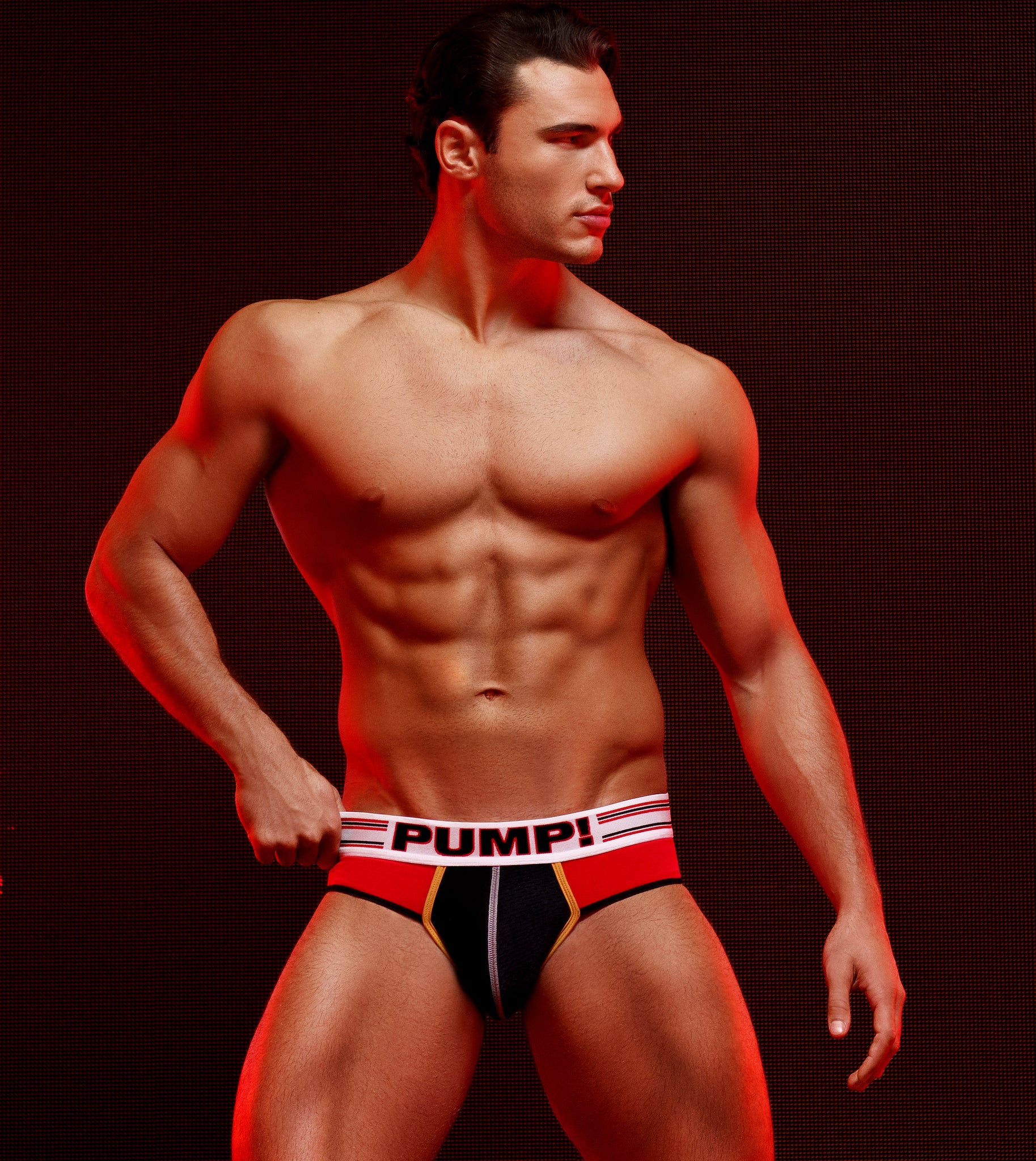
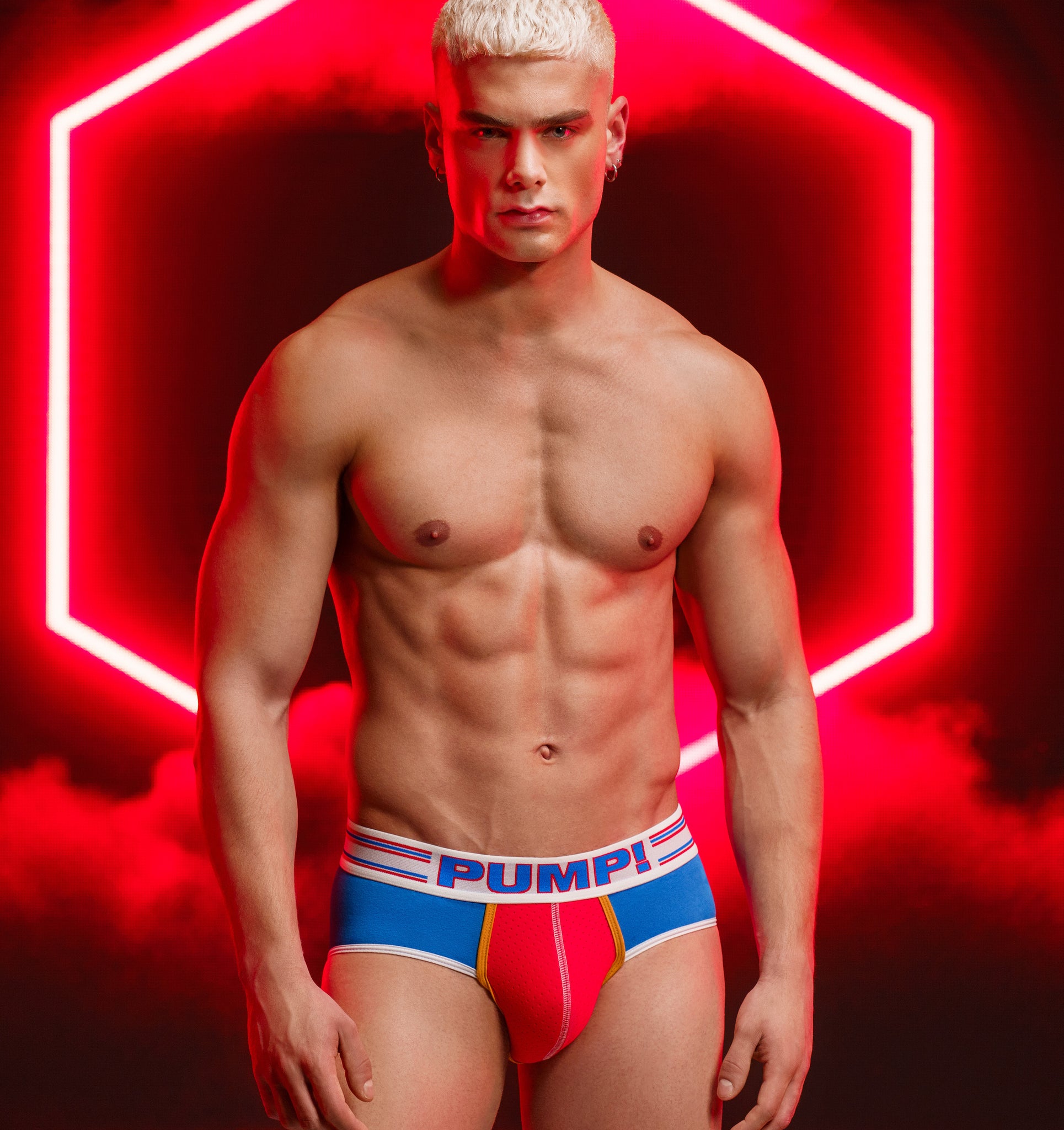
Pictured: PUMP!'s E-Racer Circuit brief (red body, black block pouch) and Velocity brief (blue body, red block pouch) — two colourways, same block-colour logic this whole article has been talking about.

A longer leg in stretch fabric that keeps the close, supportive fit of a brief but adds coverage down the thigh — the style most likely to be worn for both the gym and the office. Good for anyone who finds briefs too minimal or boxers too loose.

Shorter and squarer through the leg than a boxer brief, with a bit more room in the seat. Trunks are the style most people mean when they say "boxer briefs" without knowing the distinction — a good middle ground between minimal and full coverage.
Pictured: PUMP!'s E-Racer Circuit TouchDown Trunk — black mesh body, red and blue block-colour pouch. Same bright, hip-block styling that kicked off this whole article.
Sizing & Fit: Getting the Right Size
Most men's underwear runs closer to the body than everyday clothing, so measure your actual waist rather than going by your jeans size. If you're between sizes and prefer more room, size up.
| Size | Waist (inches) | Waist (cm) |
|---|---|---|
| Small | 28–30" | 71–76cm |
| Medium | 30.5–32" | 77–81cm |
| Large | 32.5–34" | 82–86cm |
| XL | 34.5–36" | 87–91cm |
Sizing varies a little by brand and fabric. For the full breakdown — how to measure, fit notes by brand, and a size-by-size FAQ — see our men's underwear size guide.
Why Did Movies Drop the Look?
The short answer: what reads clearly in a static, hand-drawn panel doesn't always survive contact with a moving actor under real lighting. A hard colour-block at the hip that scans as "heroic" on the page can scan as "costume malfunction" on a 40-foot cinema screen. Once studios had the budget and technology for sleeker, more tactical-looking unified suits, most dropped the trunks — Superman's own films moved away from them from the 2000s onward. It's a textbook case of a design convention outliving the problem it was built to solve, which — not coincidentally — is exactly the kind of judgement call that separates well-designed underwear from underwear that just looks like it should work.
How to Buy Genuine Men's Underwear
Counterfeit underwear is common on marketplace platforms — eBay, third-party Amazon sellers and similar. These aren't genuine, aren't made to UK safety standards, and won't match the real product on fabric, fit or durability. The simplest rule: if a brand doesn't authorise marketplace sellers, any marketplace listing — especially a heavily discounted one — isn't an approved seller. BANG&STRIKE is an authorised UK stockist for every brand we carry, buying directly and selling 100% genuine product only.
Where to Buy Men's Briefs in the UK
We've sold men's underwear since 2006 — genuine product, the latest drops, and proper aftercare: free UK delivery, next-day available at checkout, 30-day returns (unworn, unwashed, original condition), international shipping from the UK, and over 4,830 verified Trustpilot reviews from real customers.
Explore More
Go deeper on fit, fabric and sizing:
Frequently Asked Questions
Shop Men's Underwear by Style
Trading since 2006. Free UK delivery, next-day available, 30-day returns.